Chernobyl

https://www.atlasobscura.com/places/abandoned-city-of-pripyat


On April 26, 1986, during a test to see how much power was needed to keep the No. 4 reactor operating in the event of a blackout, the No. 4 reactor of Chernobyl Nuclear Station exploded causing fire, which lead in next days to huge damage of the building, releasing extremely dangerous amounts of radioactive chemicals into the air, which over time contaminated millions of square miles in dozens of European nations. The IAEA estimates that approximately 30 people were killed by the explosion and related radiation exposure, with several thousand additional deaths due to higher cancer incidence possible over the long term.

The town closest to the No. 4 reactor was Pripyat, a city of 49,000 founded in 1970 to house workers from Chernobyl. It had 15 primary schools, a large hospital complex, 25 stores, 10 gyms, along with parks, cinemas, factories, pool, amusement park, and other marks of a thriving community. Due to people, who lived there, it was one of the most beautiful and luxury city in the Soviet Union. Only about three kilometers from the explosion, the entire city was forced to complete evacuate on April 27, in just three hours. It was possible just because this scenario was part of the building plans of the plant.

Over three decades later, this ghost town is a freeze-frame of the Soviet Union in 1986. Communist propaganda still hangs on walls, personal belongings litter the streets and abandoned buildings. The hammer and sickle decorate lampposts, awaiting May Day celebrations that never took place. Toys are strewn about a schoolhouse where they were last dropped by children who are now fully grown. All clocks are frozen at 11:55, the moment the electricity was cut.

Despite the common info, city was never completely abandoned. Military, police, scientist and other public authorities use the city as base to clean radiation in the newly created zone of alienation. The famous pool was in service until 1996. There is still electricity in some part of Pripyat, and to this day there is functional vehicle base in the city, water supply for the plant, and in former laundry… there are still laundry after 30 years, where uniforms of plants workers are washed. in the same building triangle radiation danger signs are made.

Ironically, the absence of humans has been excellent for wildlife. In 1986 wildlife was not doing well in Chernobyl, outcompeted for resources by pine and dairy farms. After people left the deer and boar populations returned almost immediately, and despite having radiation levels thousands of times higher than normal, they were not showing obvious signs of mutations (though the plants got pretty weird including some actual glowing) and the animal populations grew enormously. After the elk, moose, deer and boar returned so did their predators the wolves and lynx. Today the animal populations more closely resemble that of a national park than a radioactive containment zone. As it turns out, from the animals point of view, a nuclear disaster is preferable to normal human habitation.

To tour Pripyat, Chernobyl, and other surrounding villages, one must first obtain a day pass from the government. These passes can be obtained through the touring companies located in Kyiv, about 110 kilometers from the blast site. There are five well-known tour agencies that take visitors to Pripyat. However, due to the lack of repair, the buildings and other structures in the town are becoming increasingly dilapidated. Because of this, many tour companies will not allow visitors into the buildings.

Other than the crumbling buildings, safety is not a major concern. It takes between 300 and 500 roentgens per hour of radiation to deliver a lethal dose. Levels on the tour range from 15 to several hundred micro-roentgens per hour. All tours end with a screening for radiation levels.

Already, after only three decades of abandonment, Pripyat is beginning to be swallowed up by the surrounding forest. Someday soon, it will no doubt be completely overgrown.

Auschwitz ‘The Angel of Death’

https://www.thoughtco.com/mengeles-children-twins-of-auschwitz-1779486

From May 1943 until January 1945, Nazi doctor Josef Mengele worked at Auschwitz, conducting pseudo-scientific medical experiments. Many of his cruel experiments were conducted on young twins.

Notorious Doctor of Auschwitz

Mengele, the notorious doctor of Auschwitz, has become an enigma of the 20th century. Mengele’s handsome physical appearance, fastidious dress, and calm demeanor seemingly contradicted his attraction to murder and gruesome experiments.

Mengele’s seeming omnipresence at the railroad unloading platform called the ramp, as well as his fascination with twins, incited images of a mad, evil monster. His ability to elude capture increased his notoriety as well as gave him a mystical and devious persona.

In May 1943, Mengele entered Auschwitz as an educated, experienced, medical researcher. With funding for his experiments, he worked alongside some of the top medical researchers of the time.

Anxious to make a name for himself, Mengele searched for the secrets of heredity. The Nazi ideal of the future would benefit from the help of genetics, according to Nazi doctrine. If so-called Aryan women could assuredly give birth to twins who were sure to be blond and blue-eyed, the future could be saved.

Mengele, who worked for Professor Otmar Freiherr von Vershuer, a biologist who pioneered twin methodology in the study of genetics, believed that twins held these secrets. Auschwitz seemed the best location for such research because of a large number of available twins to use as specimens.

The Ramp

Mengele took his turn as the selector on the ramp, but unlike most of the other selectors, he arrived sober. With a small flick of his finger or riding crop, a person would either be sent to the left or to the right, to the gas chamber or to hard labor.

Mengele would get very excited when he found twins. The other SS officers who helped unload the transports had been given special instructions to find twins, dwarfs, giants or anyone else with a unique hereditary trait like a club foot or heterochromia (each eye a different color).

Mengele was on the ramp not only during his selection duty but also when it was not his turn as a selector to ensure twins would not be missed.

As the unsuspecting people were herded off the train and ordered into separate lines, SS officers shouted in German, “Zwillinge!” (Twins!). Parents were forced to make a quick decision. Unsure of their situation, already being separated from family members when forced to form lines, seeing barbed wire, smelling an unfamiliar stench — was it good or bad to be a twin?

Sometimes parents announced they had twins, and in other cases relatives, friends, or neighbors made the statement. Some mothers tried to hide their twin, but the SS officers and Mengele searched through the surging ranks of people in search of twins and anyone with unusual traits.

While many twins were either announced or discovered, some sets of twins were successfully hidden and walked with their mother into the gas chamber.

About 3,000 twins were pulled from the masses on the ramp, most of them children; only around 200 survived. When the twins were found, they were taken away from their parents.

As the twins were led away to be processed, their parents and family stayed on the ramp and went through selection. Occasionally, if the twins were very young, Mengele would allow the mother to join her children for their health to be assured for the experiments.

Processing

After the twins had been taken from their parents, they were taken to the showers. Since they were “Mengele’s children,” they were treated differently than other prisoners. Though they suffered through medical experiments, the twins were often allowed to keep their hair and allowed to keep their own clothes.

The twins were then tattooed and given a number from a special sequence. They were then taken to the twins’ barracks where they were required to fill out a form. The form asked for a brief history and basic measurements such as age and height. Many of the twins were too young to fill the form out by themselves so the Zwillingsvater (twin’s father) helped them. (This inmate was assigned to the job of taking care of the male twins.)

Once the form was filled out, the twins were taken to Mengele. Mengele asked them more questions and looked for any unusual traits.

Life for the Twins

Each morning, life for the twins began at 6 o’clock. The twins were required to report for roll call in front of their barracks no matter what the weather. After roll call, they ate a small breakfast. Then each morning, Mengele would appear for an inspection.

Mengele’s presence did not necessarily cause fear in the children. He was often known to appear with pockets full of candy and chocolates, to pat them on the head, talk with them, and sometimes even play. Many of the children, especially the younger ones, called him “Uncle Mengele.”

The twins were given brief instruction in makeshift “classes” and were sometimes even allowed to play soccer. The children were not required to do hard work and had jobs like being a messenger. Twins were also spared from punishments as well as from the frequent selections within the camp.

The twins had some of the best conditions at Auschwitz until the trucks came to take them to the experiments.

Experiments

Generally, every day, every twin had to have blood drawn.

Besides having blood drawn, the twins underwent various medical experiments. Mengele kept his exact reasoning for his experiments a secret. Many of the twins that he experimented on weren’t sure for what purpose the individual experiments were for or what exactly what was being injected or done to them.

The experiments included:

  • Measurements: The twins were forced to undress and lie next to each other. Then every detail of their anatomy was carefully examined, studied, and measured. What was the same was deemed to be hereditary and was different was deemed to be the result of the environment. These tests would last for several hours.
  • Blood: Blood tests included mass transfusions of blood from one twin to another.
  • Eyes: In attempts to fabricate blue eyes, drops or injections of chemicals would be put in the eyes. This often caused severe pain, infections, and temporary or permanent blindness.
  • Shots and Diseases: Mysterious injections caused severe pain. Injections into the spine and spinal taps were given with no anesthesia. Diseases, including typhus and tuberculosis, would be purposely given to one twin and not the other. When one died, the other was often killed to examine and compare the effects of the disease.
  • Surgeries: Various surgeries were performed without anesthesia including organ removal, castration, and amputation.
  • Death: Dr. Miklos Nyiszli was Mengele’s prisoner pathologist. The autopsies became the final experiment. Nyiszli performed autopsies on twins who had died from the experiments or who had been purposely killed just for after-death measurements and examination. Some of the twins had been stabbed with a needle that pierced their heart and then was injected with chloroform or phenol, which caused near immediate blood coagulation and death. Some of the organs, eyes, blood samples and tissues would be sent to Verschuer for further study.

Twin sisters Yehudit and Lea Csengeri

19/11/2018 – 23/11/2018 Week 9

Research sources List:
Google: Googled reference images in order to create two moodboards for both me and Hannah to start executing work from.
Development
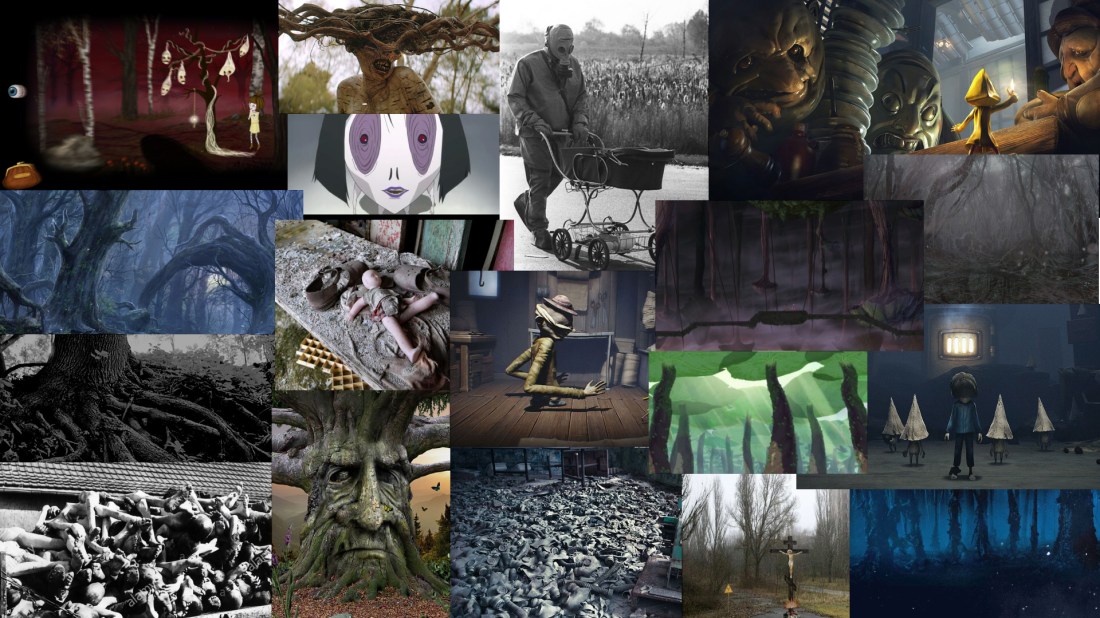
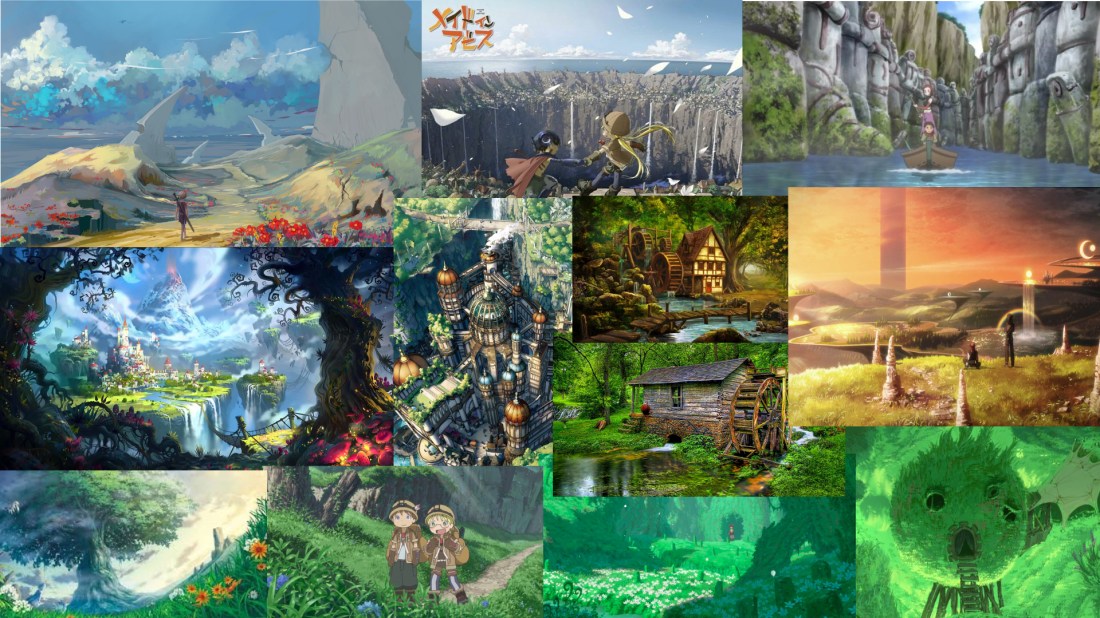
This week I developed moodboards for us both to base our work off, and to use in the future when it comes to finalising the storyboard, backgrounds and characters. I think both moodboards reflect exactly how we would envision both the different worlds to look like, in the sense of colour and texture. I also started researching more animations and games which can be used as inspiration as well as historical research on human atrocities which we are hoping to incorporate into our animation as quite a strong message.
Strengths
Even though there is only two of us we have quite a clear understanding on how we both would like this animation to look, especially now that it’s taken a darker turn, we want to make sure we are representing the historical references with a high quality animation and storyline.
Areas to Develop
We need to both get our designs for the characters refined and what they stand for so that I can start putting together a storyboard that we can both work from. I don’t see the point in attempting a storyboard with camera angles and backgrounds when one of the key components is how our main character interacts with the creatures so I need to be completely sure on which ones we are using and then I can adapt them into the story.

Moodboards

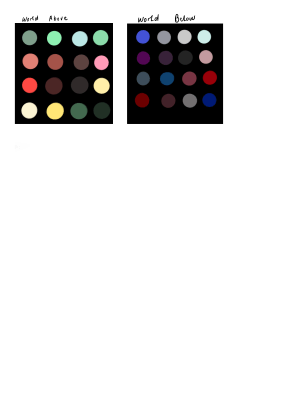
Colour Script

colourr.png

This week I knew I needed to start figuring out more design ideas for our worlds as these are going to be a crucial part of our animations. I decided to reflect back on my blog and find loads of really fitting reference images which are going to help immensely when coming up with our ideas. I have forwarded these onto Hannah who loves them and is happy with everything to move forward.

Moodboard for ‘Under world’
moodboard for underworld.jpg

Moodboard for ‘Upper World’

moodboard for upperworld.jpg